


Most bakeries already know where their day gets eaten up. It might be the shaping bench, with three people rolling croissants by hand. It might be proofing, when every rack slot is full and the next batch has nowhere to go. Or it might be the oven, holding up everything behind it.
A faster machine only pays off if it fixes that particular step. Put capacity somewhere the line already has spare time, and you have moved numbers on a spreadsheet rather than throughput at the loading door.
So start with two things: the product you intend to sell, and how much of it you need per shift. Forming, proofing and baking all follow from those two numbers.
Gondor supplies commercial bakery equipment across those three stages: bread molders, a pastry dough sheeter, a croissant roller, a rotary cookie forming machine, proofing cabinets, and ovens built for tray, rack, tunnel and conveyor loading. This guide walks through what each one does, and what to settle before you ask anyone for a quote.
Find equipment for the product you make
Flour, water, yeast and salt go into all of it. The equipment list changes completely depending on whether you are aiming at a sandwich loaf, a croissant or a molded cookie, and those three rarely share a machine.
| Your product | The process to review | Equipment to consider |
| Sandwich loaves and pan bread | Shaping dough for the baking pan, proofing and baking | Pan bread molder, proofing cabinet and an appropriate bakery oven |
| Baguettes and long loaves | Forming to length while managing dough condition | Baguette molder, proofing equipment and an oven suited to the required crust |
| Croissants and laminated pastry | Sheeting, folding, cutting and rolling | Pastry dough sheeter and croissant roller, with separate preparation and temperature management |
| Molded cookies and shortbread-style biscuits | Forming dough into repeatable shapes | Cookie forming machine and a suitable batch or continuous oven |
| Pizza | Matching the baking cycle to the base and toppings | Conveyor pizza oven, with dough preparation and topping stages defined separately |
Product first, always. If you are running an existing bakery, walk the line on a busy morning and note where work piles up or hands are waiting. That observation usually tells you more than any nameplate rating.
Choose the right dough forming equipment
Forming is where most bakeries either gain or lose the most labour, and where the widest range of machines sits.
Pan bread molders for sandwich loaves
A pan bread molder takes divided, rested dough pieces and shapes them into the tight cylinder that drops into a baking tin. For sandwich loaves and similar pan-baked products, the pan bread molder is where to start looking.
Three details decide whether a given machine suits you: dough piece weight, your tin dimensions, and what you want the finished loaf to look like when it is sliced. Send all three and we can size it properly.
Also settle how pieces reach the machine and how they travel into the tins afterwards. Those two transfers usually set the real pace of the line. A molder rated well above your required rate does nothing for you if two people are still placing tins by hand.
Baguette molders for long loaves
Baguettes ask something different of the dough. A baguette molder forms pieces to length without overworking them, which is why it is not simply a pan bread molder with the settings changed.
Send the target piece length and weight alongside the recipe. Hydration and flour strength change how a piece behaves under the rollers, and the recipe is what sets both.
When you assess samples, judge the baked loaf: length, surface condition, crumb structure and crust. A raw piece can look perfect on the bench and still bake out short or blistered.
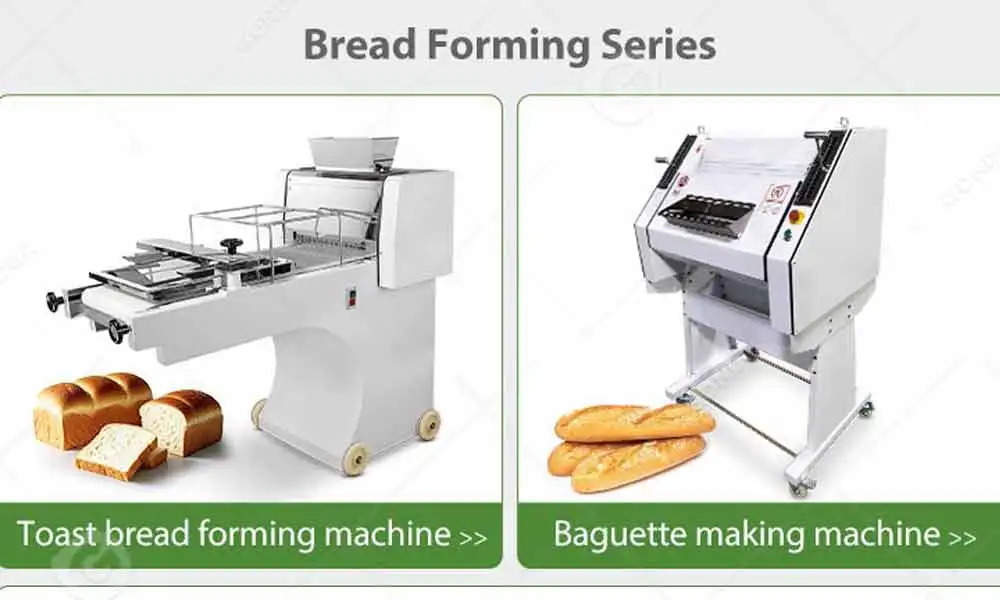
Pan bread and baguette forming equipment. Match the forming method to the loaf you want to produce.
Dough sheeters for pastry preparation
A pastry dough sheeter brings dough down to a controlled, repeatable thickness. In laminated pastry work it handles the reduction passes between folds, so each block comes out even before it reaches the cutter.
Size it around your batches: working width, and how much dough you can safely load. Keep floor space clear at both ends, since operators need room to feed the sheet in and catch it coming out.
Be clear about what a sheeter does not cover. Lamination is a sequence: folding, incorporating fat, resting, cooling and cutting. A sheeter is one machine inside it. Buying it does not give you the rest. If pastry volumes are climbing, plan the whole sequence even if you only purchase one piece now.
Croissant rollers for prepared dough pieces
The croissant roller making machine takes a cut triangle and rolls it. That is the whole job, and it starts where the cutting table finishes.
Two things decide the outcome: triangle geometry and dough temperature. A triangle cut slightly off, or dough that has warmed and relaxed on the bench, will roll loose or crooked on any machine.
If you are replacing hand rolling, look at consistency first and speed second. Uniformity is usually the reason the purchase gets approved. Count the people either side of the roller too: one feeding, one placing trays. Those hands belong in your costing.
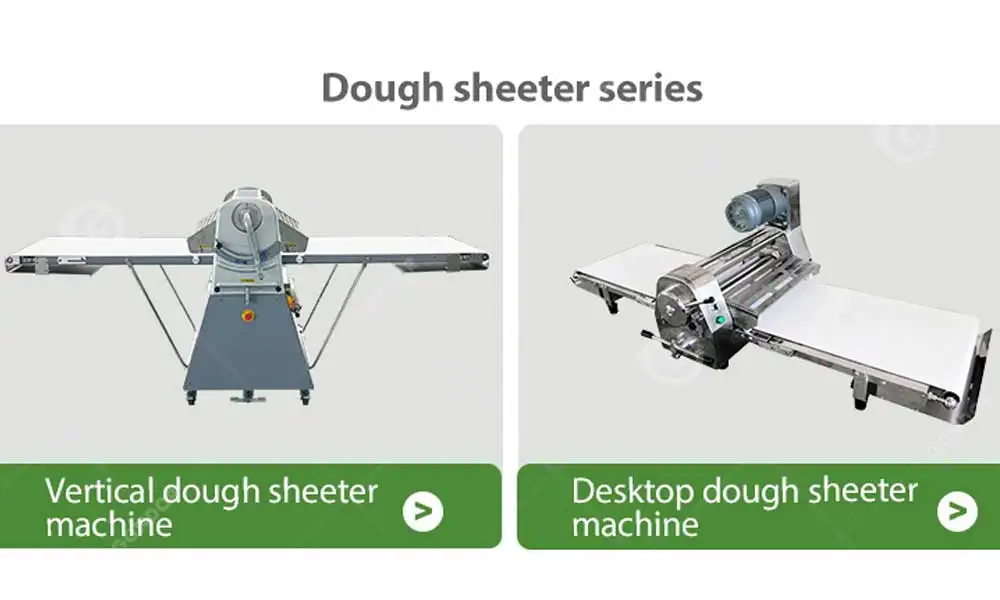
Floor-standing and tabletop sheeters prepare dough sheets upstream of cutting and croissant rolling.
Cookie forming machines for molded dough
The shortbread cookie machine forms dough by rotary molding: dough is pressed into engraved rolls and ejected onto the belt. This is not depositing soft dough through a nozzle, and it is not wire cutting. Buyers sometimes expect one machine to cover all three. None does.
Rotary molding is fussy about dough. Short, low-elasticity doughs release cleanly from the roll; stickier mixes smear or tear out. Send the formula, list any inclusions, and describe the target shape before we quote tooling.
Trial it with your own dough, then judge the baked piece: did the pattern survive the oven, did dimensions hold, and was release clean at production speed rather than during a slow demonstration.
Match proofing capacity to your production flow
Bakery proofing equipment rarely gets the attention it deserves, and it often caps output before anything else does. Proofing gives yeasted dough time to develop before it meets the oven, and a commercial dough proofing cabinet puts temperature and humidity under control, so the rise repeats batch after batch instead of depending on how warm the room is that morning.
Sizing is where projects go wrong. Tray count is the number everyone quotes, and on its own it means very little. You also need tray dimensions, clearance for the dough to expand, and how long each load occupies the cabinet. Two bakers using identical trays can need quite different capacities if their proofing times differ.
Then line it up against the molder. If pieces fill trays faster than the proofer can release them, dough backs up onto benches and racks in the aisle. Work backwards from your hourly target and proofing time, and allow floor space for whatever is waiting.
Settings follow the product. Lean doughs, rich doughs, laminated pastry and pizza bases each want their own temperature and humidity. If you also need to hold dough overnight under refrigeration, order that separately. A retarder cabinet is built differently from a standard proofer.
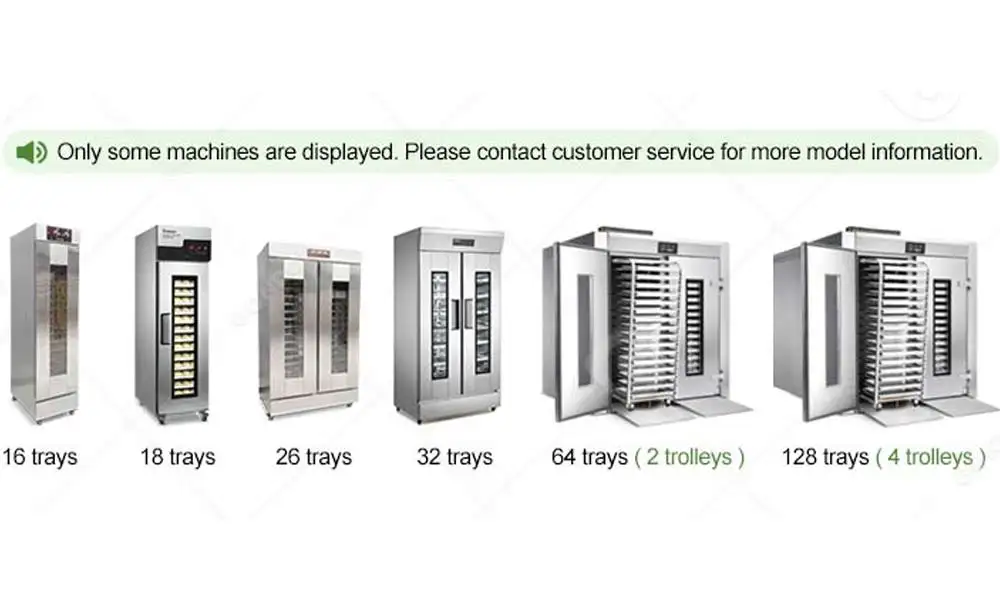
Proofing cabinet layouts vary. Confirm tray dimensions, holding time and the configuration quoted for your project.
Compare bakery ovens by loading method and production rhythm
The oven sets the pace of everything upstream, and it is the easiest of the three stages to buy wrong. Every oven reaches baking temperature. The differences that matter are how much product you can load at once, how that load moves through the chamber, and which energy source your building can actually support.
Decide the loading method first: batches, or continuous feed. Almost every other question follows from that answer.
Convection ovens for tray-based batches
A convection oven moves hot air around the load, so trays bake more evenly than in a deck oven, and the chamber recovers faster after the door opens. For bakeries running mixed products on trays, the commercial convection oven range is usually where these conversations start.
Test it loaded. Tray spacing, loading pattern and airflow all interact, and one half-empty tray tells you close to nothing about a full production rack. Bring your own product, fill it the way your bakers will, and compare the corners against the middle.
Confirm the heating configuration on the quoted model, plus any steam injection or humidity control your crust depends on.
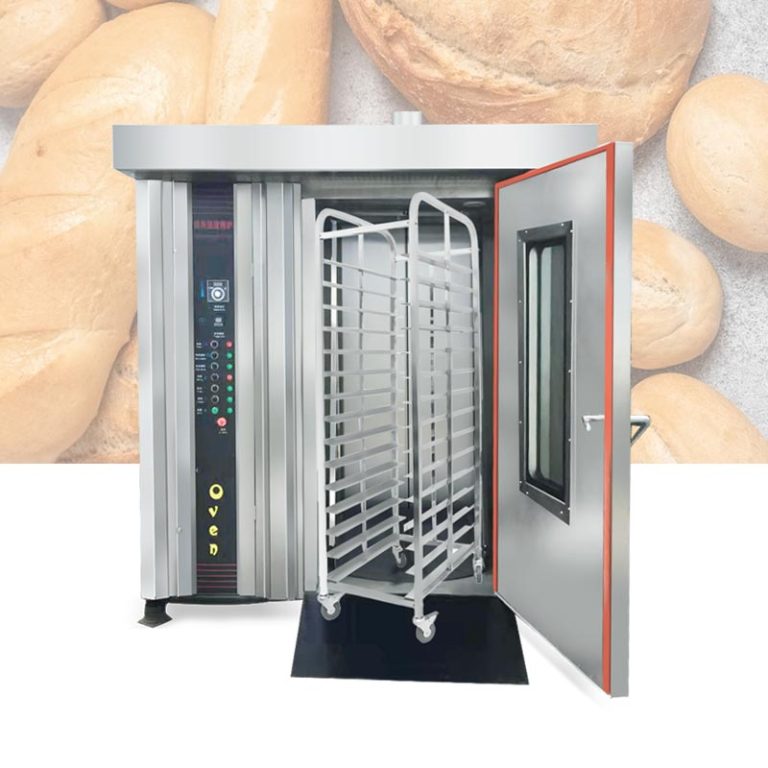
Rotating rack ovens for rack-based baking
A rotating rack oven takes a loaded rack and turns it through the bake. If your process already runs on racks of trays rather than loading tray by tray, this is the format to look at.
Build the full cycle before you compare capacities: rack preparation, wheeling it in, the bake, wheeling it out, unloading. Then check the floor plan. The oven needs approach space at the door and somewhere for loaded racks to stand either side of baking, and that space rarely exists by accident.
Compare usable load rather than nominal tray numbers. Product height, spacing and the browning you want decide how many trays actually ride the rack.
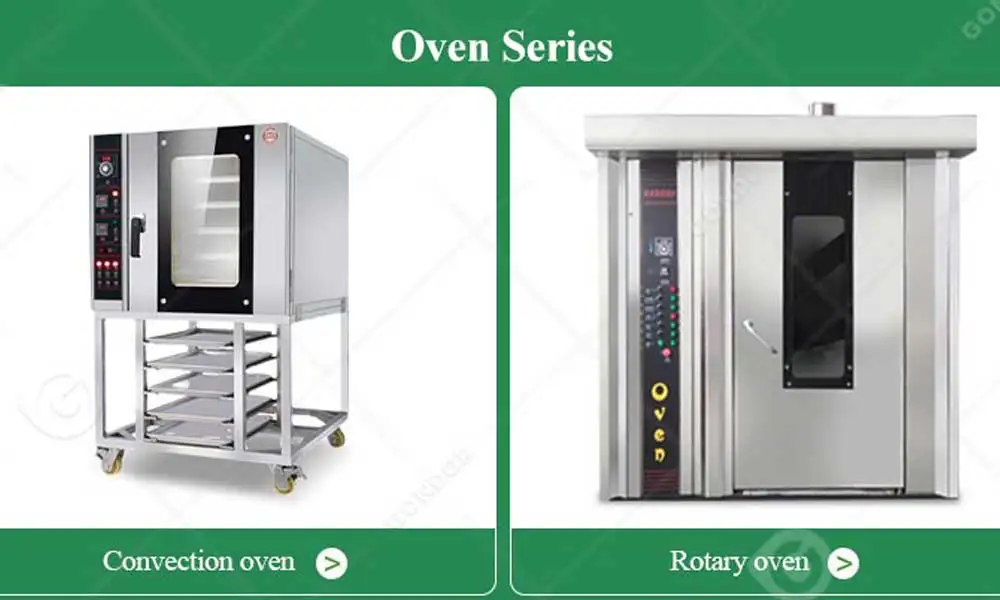
Convection and rotary rack oven formats. Compare loading access and the complete batch cycle.
Tunnel ovens for continuous production
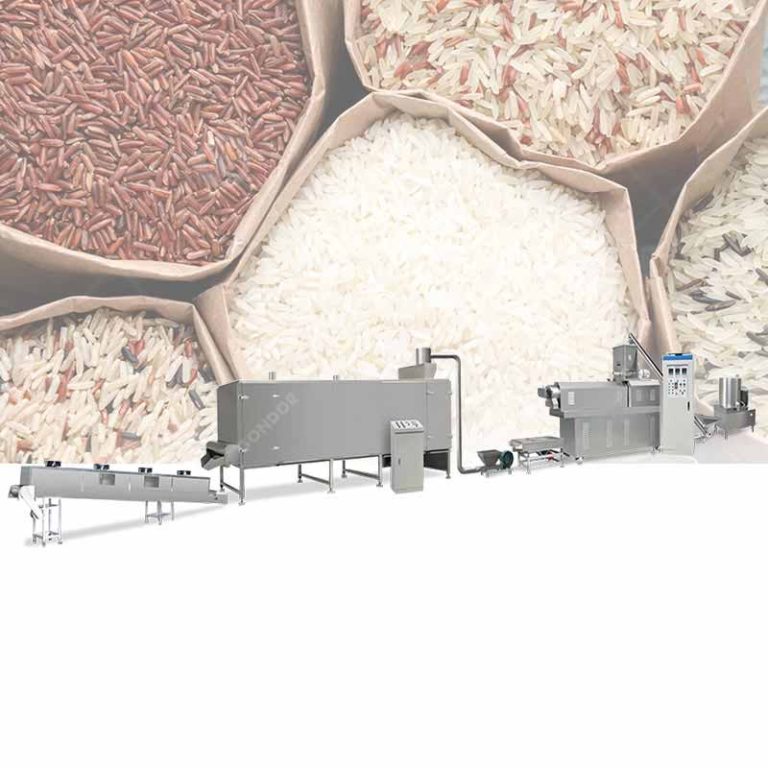
An industrial tunnel oven for bakery production carries product through a heated chamber on a continuous conveyor. It rewards steady running and punishes stop-start work.
Specify baking time, usable belt width and product spacing together, because changing one moves the other two. Upstream has to feed continuously at that rate, and cooling, freezing or packing equipment downstream has to absorb it. A tunnel oven with no cooling line behind it simply moves the queue further down the room.
For long runs of one product, it is hard to beat. Short runs with frequent recipe changes, irregular orders or a tight floor will probably point you back to a batch oven. Tunnels are long too, which is its own constraint.
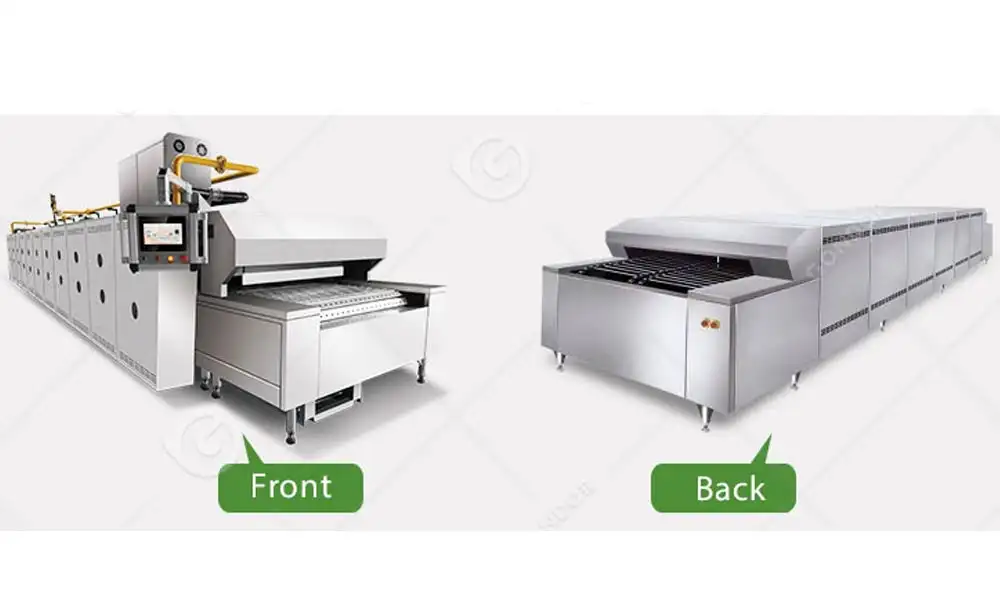
A tunnel oven needs space and suitable handling at both ends of the conveyor.
Conveyor pizza ovens for a defined baking cycle
The commercial conveyor pizza oven carries pizzas through the heated zone on a belt. Belt speed and heat settings together set the baking cycle, so once both are dialled in, every pizza gets the same treatment.
Give us diameter, base thickness and topping load. Also tell us what goes in: raw, par-baked, chilled or frozen. Each starting condition needs a different belt time and zone temperatures.
Test with your own pizza, using your dough and your sauce load, and judge base, rim and toppings together. Then time the loading and unloading at each end. Handling at the outlet is easy to overlook, and it frequently decides how many pizzas actually leave the kitchen.
| Oven type | When to evaluate it | Main points to confirm |
| Convection oven | Tray-based batches across a defined product range | Tray spacing, airflow, usable load and model configuration |
| Rotating rack oven | Production organized around loaded racks | Rack fit, batch cycle, loading access and waiting space |
| Tunnel oven | Sustained production with a steady product flow | Baking time, conveyor loading, upstream feed and downstream handling |
| Conveyor pizza oven | Repeated pizza baking with a defined travel time | Product size, starting condition, toppings and belt loading |
One caution on naming. A rotating rack oven usually works by convection, and a conveyor pizza oven is technically continuous. The categories overlap, so compare how product is loaded and how heat is delivered, and let that decide.
Connect the machines into a workable production setup
Machines rarely fail on their own spec sheet. They fail in the gaps between them. The sequences below are typical starting points for discussion; your recipe and product will adjust the order.
Sandwich bread: mixing and dough preparation → dividing and any required resting → molding and panning → final proof → baking → cooling → slicing or packing.
Croissants: dough preparation and temperature management → sheeting and folding to build layers → final sheeting and cutting → rolling → proofing where required → baking → cooling and packing.
Molded cookies: mixing → rotary molding and transfer → baking → cooling → packing.
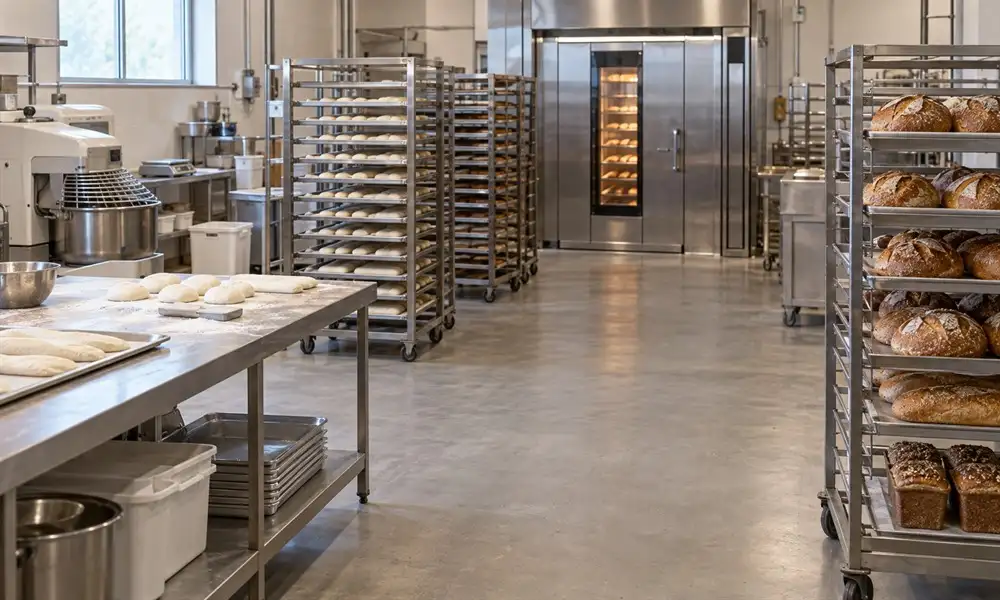
Illustrative scene: allow space for preparation, rack movement and cooling when planning the process.
Write down the work between machines before ordering: who moves trays, how pieces are transferred, and where product sits when the next machine stops. Those answers cost nothing now and a great deal later.
Ask for the quotation to separate three groups: equipment they supply, machines you already own, and items sourced elsewhere. Mixers, cutters, coolers, slicers and packers belong in the quote only when the agreed scope includes them.
Set capacity targets that reflect actual output
“Pieces per hour” means little on its own. Attach product weight, dimensions and your quality standard, and say whether you counted pieces formed or pieces saleable. The same goes for “kg per hour”: dough weight and finished weight differ by bake loss.
Start from what you must ship per shift, then subtract. Cleaning, changeovers, breaks, dough rests and the ordinary interruptions all come off clock time before any useful running time is left. What remains is the figure to plan against.
Worked example: 12,000 saleable pieces across six usable hours means an average of 2,000 saleable pieces an hour. The arithmetic shows the method and is not a rating for any machine on this page.
Then check whether the configuration can hold that number after losses. Maximum forming speed and sustained finished output are two different figures, and the second one is what you invoice against.
Review every stage on the same basis. A proofer holds trays for a fixed window, a batch oven runs cycles, a conveyor oven takes a continuous stream. Line those up against the shift and the constraint usually shows itself.
That comparison is also roughly where commercial bakery equipment sized for one or two shifts gives way to industrial bakery equipment built for continuous running. The crossover arrives earlier than most buyers expect — often when a second shift starts, or when one product begins dominating the schedule.
Adding oven capacity will not help a proofer that is already full, or a packing table that cannot clear what it currently receives.
Check space, utilities and changeovers before ordering
Floor plans lie in one predictable way: the machine fits, and nobody can work at it. Allow operating clearance, cleaning access and maintenance room, and check the route in: door widths, corridor turns, whether there is a lift at all.
Mark doors, columns and ceiling height on the drawing, and trace how trays and racks move through the room. A sheeter needs space at both ends for handling dough sheets. An oven needs a clear loading zone and somewhere to set down hot product.
Lock the electrical supply early: voltage, frequency, phase and the capacity available on site. For fuel-fired equipment, specify the fuel, storage and supply conditions. Ventilation, exhaust and heat rejection belong in the installation scope from the beginning.
Then run through cleaning and changeovers against your daily mix. Which parts come off, who removes them, where they get washed, and how settings are brought back. Follow the cleaning method approved for each machine.
If you change recipes often, and most bakeries do, discuss tooling, contact surfaces and access before you order. Changeover time quietly erodes more capacity than any specification sheet admits.
Compare quotations and product trials on the same basis
A quote is only comparable if everyone priced the same job. Before lining up numbers, check that each supplier has quoted the same product, output and scope. Most apparent price differences come from assumptions, not machines.
Use one checklist across every enquiry:
- Finished product, dough characteristics and target output.
- Machine models, working dimensions and selected options.
- Trays, racks, molds, tooling and other accessories.
- Transfers, controls and any remaining manual operations.
- Utility requirements and installation responsibilities.
- Training, documentation, spare parts and service scope.
- Trial conditions and the results required for acceptance.
Run the trial on the food, not only on the machine. Bread: shape, crumb and crust. Croissants: whether the layers opened and held their shape. Cookies: mold release and pattern definition after baking.
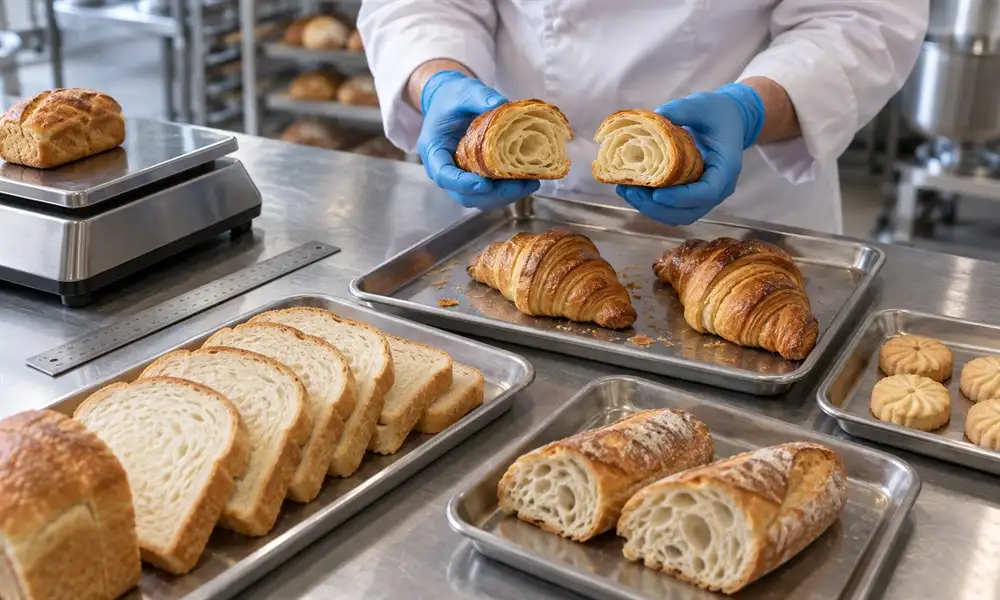
Illustrative scene: evaluate finished-product structure and consistency alongside machine performance.
Energy deserves the same scrutiny. Installed power and consumption per batch are different quantities, so ask how any consumption figure was measured and under what load.
FAQs
Discuss your bakery equipment requirements
Tell us what you want to make, and which part of the process hurts. A few specifics get a useful answer back much faster:
- Product name, photos, size and weight.
- Required output per hour or per shift.
- Dough or recipe characteristics relevant to processing.
- Existing machines you plan to retain.
- Available floor space and utility supply.
- Required equipment scope, destination country and project schedule.
Discuss your bakery equipment requirements with Gondor.